You just signed the paperwork on a new excavator, and as you’re shaking hands with your dealer, they mention a Customer Value Agreement. But what exactly does that mean? You might wonder whether it’s worth the investment or how it’s different from the warranty.
This guide clears up the confusion. You’ll learn what a Cat® CVA is, what it includes and the different plan options available.
Jump to Sections:
- Cat CVAs Explained
- The Four Parts of a Cat CVA
- How a CVA Differs From a Warranty or ESC
- Who Should Get a CVA?
- What Does a Cat CVA Cost?
- How to Get a CVA Through MacAllister Machinery
- CVA Plan Options
Cat CVAs Explained
A Cat CVA by Cat Financial is a customizable ownership and maintenance plan for Cat equipment. It’s a proactive structure around your equipment rather than a reactive scramble when something breaks.
Instead of managing maintenance on your own — ordering parts when something fails or scheduling service after a breakdown — a CVA creates a predictable framework. Your dealer handles parts delivery, scheduled maintenance, remote monitoring and expert support. You get streamlined access to genuine Cat parts, dealer-performed service and peace of mind through equipment health tracking that lets you monitor key operating metrics anytime, anywhere.
A CVA is not a warranty. Warranties cover defects in materials and workmanship. A Cat CVA covers the ongoing work of keeping equipment healthy throughout its entire life cycle.
Plans are flexible. Cover one piece of equipment or an entire fleet. Enroll new pieces of equipment or add older ones to your agreement. You can also explore this glossary for a clearer breakdown of CVA terminology and concepts.
The Four Parts of a Cat CVA
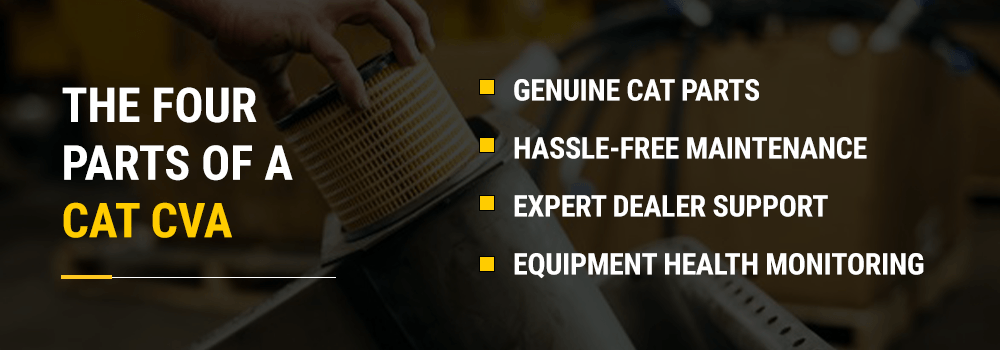
Every CVA is built around four core components, which address specific pain points in equipment ownership and create a comprehensive support system. These pillars work together to reduce downtime, create more predictable maintenance costs, increase equipment value and boost your confidence in uptime.
1. Genuine Cat Parts
Genuine Cat parts come from the same company that manufactured your equipment, ensuring an exact fit, warranty protection and reliable performance. Original equipment manufacturer (OEM) parts meet exact specifications. Aftermarket alternatives, by contrast, come from third-party manufacturers and may not meet the same standards.
Parts delivery is scheduled to arrive at your jobsite or shop ahead of each service interval under a CVA. You don’t chase down filters or fluids. Your dealer handles it.
2. Hassle-Free Maintenance
Your dealer manages your scheduled preventive maintenance intervals, not you. A CVA simplifies ownership with streamlined parts access and flexible payment options tailored to your business.
CVA-scheduled servicing ensures certified dealer labor and adherence to operating hours, optimizing performance and extending life cycles. This approach keeps your factory warranty and extended coverage intact because the work meets manufacturer specifications.
Skipping or delaying service carries hidden costs. Voided coverage, accelerated wear and higher repair bills add up quickly. Teams that rely on reactive maintenance are likely to experience more downtime than those using preventive strategies. For a midsize contractor running five to 10 pieces of equipment, that could translate to thousands of dollars in lost revenue per breakdown. The difference between reacting to failures and preventing them is measurable.
Oil changes and fluid checks form the foundation of equipment health. When preventive maintenance services handle these tasks on schedule, you avoid the downtime and expense that come from deferred care.
3. Expert Dealer Support
Certified technicians complete proper maintenance and repair protocols using genuine parts and advanced diagnostics. Pre-arrival diagnostics mean technicians show up knowing what’s wrong before they get there. Dealers can review connected equipment data and health alerts before dispatching help. Technicians identify the root cause or narrow down troubleshooting steps ahead of time.
Arriving with the correct diagnosis and components ensures the repair appointment runs as quickly and smoothly as possible. For example, when your dozer throws a code, experienced technicians can pull fault history remotely, identify a failing pressure sensor and arrive with the correct OEM part, so you don’t have to wait longer than necessary to get back to work.
Progress updates during service provide transparency into what’s being done and when you’ll have your equipment back.
4. Equipment Health Monitoring
Cat Product Link™ connects your equipment to your dealer’s service team through a telematics system that collects engine hours, fault codes, fuel efficiency trends and idle time. This information transforms maintenance from reactive fixes to proactive care by spotting early signs of wear, predicting failures and alerting teams before breakdowns happen.
Cloud-based sensors track performance in real time through health monitoring. When a component shows signs of stress, you know about it before it fails on the job. Oil and fluid analysis for contamination or dilution become routine checks rather than emergency diagnostics.
VisionLink® is the operator-facing dashboard where fleet managers view critical information in real time. It turns raw numbers into clear, actionable insights, helping equipment owners monitor health and manage utilization to reduce downtime and control operating costs. All fluid analysis results are now accessed exclusively through VisionLink.
How a CVA Differs From a Warranty or ESC
Understanding the difference between a CVA, a warranty and an Extended Service Coverage (ESC) clears up common buyer confusion. Each serves a distinct purpose.
CVAs are proactive maintenance plans focused on upkeep. Warranties provide free, factory-backed guarantees against manufacturing defects. ESC offers paid protection for major component failures after the base warranty expires.
For example, if a hydraulic pump fails at 800 hours due to a manufacturing defect, the warranty covers it. If the same pump fails at 3,500 hours due to unmonitored contaminated fluid, ESC may cover the pump replacement. However, a CVA could have caught the contamination early through routine oil sampling, preventing the failure entirely.
The CVA covers ongoing work to maintain equipment health through parts, service and monitoring, working alongside warranties and ESC rather than replacing them. ESC functions as a factory-backed warranty extension for component failures beyond the original warranty period, covering repairs without managing routine maintenance.
Here are the key differences:
- Purpose: CVAs keep equipment properly maintained through scheduled servicing. Warranties protect owners from paying for factory flaws or broken parts on new equipment. ESCs shield them from unexpected repair bills after the original warranty ends.
- Cost: CVAs are purchased as tailored service and parts packages, often bundled into equipment financing. The original purchase price automatically includes warranties, while ESC must be purchased separately as an upgrade plan.
- Coverage: Routine maintenance items like genuine filters, fluids, oil sampling and dealer inspections fall under CVAs. Warranties address unexpected failures from poor factory build or defective materials. ESC handles major parts and labor for covered mechanical or electrical component breakdowns.
- Timing: Equipment owners can add CVAs at any point during the life cycle. Warranties operate on strict start and end dates. ESC generally must be registered before the standard factory warranty expires.
Warranties respond to failures, while CVAs work to prevent them. CVA-maintained equipment is more likely to have warranty claims honored because documented maintenance demonstrates you have properly cared for it.
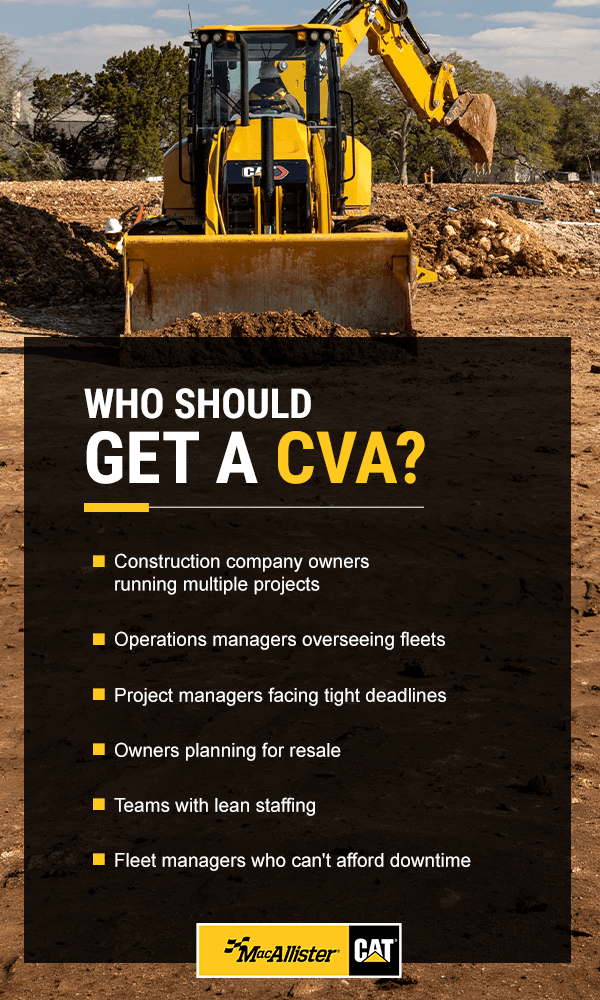
Who Should Get a CVA?
A CVA often makes sense for:
- Construction company owners running multiple projects: A CVA takes maintenance off your plate. You don’t need to track intervals, chase parts or guess when service is due. You get one line item in your budget and a predictable cost.
- Operations managers overseeing fleets: Health monitoring and fluid analysis give you visibility into every piece of equipment. You see problems before they become breakdowns. Downtime becomes planned, not reactive.
- Project managers facing tight deadlines: Prompt repair response and pre-arrival diagnostics mean faster turnarounds when something does go wrong. A CVA won’t prevent every failure, but it dramatically shortens the recovery.
- Owners planning for resale: Detailed maintenance records from a CVA can increase future resale pricing.
- Teams with lean staffing: Outsource labor and routine servicing directly to certified technicians when dedicated maintenance crews aren’t available.
- Fleet managers who can’t afford downtime: Planned maintenance and rapid dealer service commitments protect operations that cannot afford unexpected equipment failures.
What Does a Cat CVA Cost?
CVA pricing isn’t one-size-fits-all or published as a flat rate. Several factors impact the final number, including:
- Equipment model and age.
- Plan tier selection.
- Number of equipment pieces.
- Coverage term.
- Application type and how hard the equipment is worked.
Many plans allow rolling expenses into monthly equipment payments, making it a cash-flow-friendly option rather than a large up-front expense.
Consider a CVA an investment, not an expense. Compare the predictable monthly payment against the unpredictable outlay for a single major repair event plus downtime losses. The best way to get accurate pricing is to talk to your dealer. They can help you build a plan around your actual equipment and usage.
How to Get a CVA Through MacAllister Machinery
MacAllister Machinery serves Indiana and Michigan’s lower peninsula with several locations and a full-service team. Set up CVAs at the time of new equipment purchase or add them later for existing equipment. We’ll walk you through a brief consultation, equipment review, plan recommendation and enrollment. The entire process typically takes a few business days from consultation to enrollment, and coverage can begin as soon as your next service interval.
Adjust your coverage as your fleet changes. You can easily add equipment or upgrade tiers. For more information, visit our Customer Value Agreements page or explore details on the next-day parts and two-day repair guarantee.

CVA Plan Options
MacAllister Machinery offers three coverage tiers, from lightest to most comprehensive. Each tier serves different operational needs and budgets:
- Bronze: The Bronze tier provides entry-level coverage focused on planned maintenance parts and basic equipment connectivity. This plan works best for owners with in-house service capability who want parts delivered on schedule. Parts ship directly to the customer. Cat fluids and annual inspections are available at an additional cost.
- Silver: The Silver tier adds dealer-performed preventive maintenance and inspection services to the mid-tier offering. Silver includes fluid analysis through VisionLink, filter changes and preventive maintenance inspections per Cat specifications. Shop preventive maintenance labor is included, and the repair response guarantee applies. Qualifying service can be completed by the committed date or by the end of the second business day after authorization.
- Gold: The Gold tier delivers the most comprehensive coverage available. MacAllister Machinery manages all maintenance and covered repairs, including labor, parts, fluid analysis and the full Services Commitment guarantee — next-day parts and two-day repair response. Fleets or owners who want to eliminate surprise costs benefit most from this choice. It provides maximum support, uptime protection and predictable maintenance management.
All three plan types include Cat-recommended filters and parts, primary engine air and cabin air filters, condition monitoring, oil sampling and reporting and a VisionLink subscription.
Mix and match tiers from MacAllister Machinery for a customizable pricing plan tailored to your business. An operations manager might run Bronze on newer equipment, Gold on older high-hour units and fluid analysis across everything. For exact tier details, verify current Gold, Silver and Bronze inclusions online.
Frequently Asked Questions About CVAs
These are some common questions about Cat Customer Value Agreements:
Frequently Asked Questions
Can I get a CVA for used Cat equipment?
Yes, you can get a CVA for used Cat equipment in most cases. MacAllister Machinery can build a CVA around used and existing equipment regardless of age, typically following an equipment inspection to establish a baseline condition.
What happens if MacAllister Machinery misses a service commitment?
For Silver and Gold plan tiers, MacAllister Machinery’s CVA includes a Services Commitment that guarantees next-day parts delivery and two-day repair response. If we miss either expectation, you may receive up to $1,000 in Cat Credits. Credits act as a direct financial backup to compensate for unexpected downtime when dealer labor and service commitments go unmet.
You can use this credit toward maintenance and common repair parts not covered by warranty or an Equipment Protection Plan. This immediate discount applies to your next qualifying Cat purchase.
Can I cancel a CVA?
You can cancel most CVA plans within 30 days with no fees if you didn’t use any benefits. CVAs are flexible, and you can adjust coverage as your fleet changes.
Keep Your Operations Moving Forward
When you choose a CVA through MacAllister Machinery, you’re partnering with a dealer that has over 80 years of experience. Our specialists know Cat equipment inside and out, and we’re committed to helping your fleet perform its best. We offer mobile service capabilities reaching jobsites across Indiana and Michigan’s lower peninsula. Whether you’re running a single piece of equipment or managing an entire fleet, we can build a plan around your actual usage, budget and uptime goals.
Ready to learn more about how a CVA can meet your business needs and extend your equipment’s life? Contact our team to discuss your operation, or find your nearest location to talk with a specialist in person. We’ll walk you through your options, answer your questions and help you decide if a CVA is the right fit for your fleet.