Fleet managers, how do you typically approach equipment procurement? While building a diverse fleet gives you a wider variety of options, it can complicate everyday operations like maintenance and operator training.
Fleet standardization is an approach to heavy equipment fleet management that involves building a fleet with only one make of equipment. Your entire fleet comes from one brand and is stored in the same location. This arrangement can boost your company’s efficiency, mitigate the risk of unplanned downtime and offer many benefits.
Jump to Sections:
- Why Does Fleet Standardization Matter?
- The Benefits of Fleet Standardization
- Common Challenges of Fleet Standardization
- Solutions for Fleet Standardization Challenges
- How Technology Enhances Heavy Equipment Fleet Standardization
- Standardizing Your Fleet For the Future
Why Does Fleet Standardization Matter?
Fleet standardization is advantageous for:
- Construction: A standardized fleet can help keep projects on schedule and under budget by providing consistency for operators and equipment technicians between jobsites.
- Landscaping: Providing standard equipment like mowers and trimmers helps improve efficiency and customer satisfaction by reducing maintenance downtime and making it easy for operators to adapt to different jobsites.
- Utilities: You can enhance your utility’s reliability and shorten response times with a standardized fleet of bucket trucks, cable pullers, digger derricks and more.
- Mining: A standardized fleet enables you to reduce downtime in harsh mining environments and optimize maintenance schedules to prevent dangerous breakdowns.
- Civil engineering: Streamline project management and cost control processes with a fleet that ensures consistent performance across all your projects.
- Forestry: A standardized fleet provides greater reliability when working on diverse terrain. Additionally, operators can more easily adapt to various tasks when using equipment with familiar controls.
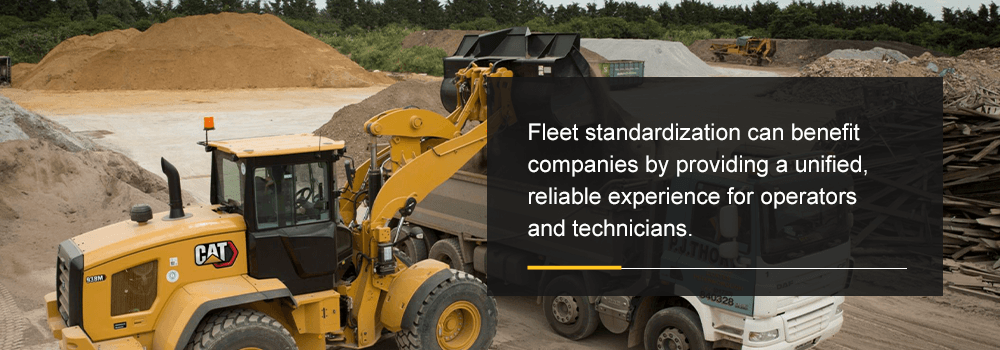
Ultimately, fleet standardization can benefit companies across various industries by providing a unified, reliable experience for operators and technicians.
The Benefits of Fleet Standardization
The operational benefits of fleet standardization include efficiency improvements, cost savings and increased safety. Proper planning and strategic implementation are critical for achieving these benefits.
1. Operational Efficiency Gains
Standardization is excellent for enhancing fleet productivity and efficiency. Employees who are familiar with the brand your company uses already know the ins and outs of the equipment, including any unique quirks to look out for.
With less variation in your fleet, employees can spend less time learning new machinery and more time focusing on core operational tasks.
When you need a specialized piece of equipment that you use too rarely to include in your permanent fleet, you can rent it from a reliable provider. You could also upfit certain vehicles in your fleet to match those specialized needs without sacrificing standardization.
2. Cost Benefits and Savings
Although you may need to put forward a significant capital investment, a standardized fleet helps reduce fleet costs in the long term.
The areas where you can see the cost benefits of fleet standardization include:
- Maintenance: Technicians who are confident in working with a specific brand can repair equipment more efficiently, reducing downtime and minimizing waste.
- Training: A standardized fleet lets you create standardized training programs that save time and associated costs.
- Inventory: You can store fewer parts at a time because all your equipment is from the same brand, which reduces holding expenses.
- Purchasing: You can often simplify the procurement process by eliminating the need to compare multiple makes and models. You can also purchase standardized parts in bulk, which lets you take advantage of volume discounts.
- Resale: Reselling a standardized fleet is often easier than selling diverse models from various brands because demand is higher for uniform makes and models.
3. Streamlined Maintenance Processes
Fleet standardization enables you to eliminate inefficiencies in your preventive maintenance processes, helping to maximize equipment uptime and enhance your profitability.
Maintenance is the second biggest cost factor in fleet management, accounting for about 22% of total fleet costs. Standardizing your fleet can help you reduce those expenses and minimize both planned and unplanned downtime.
The most significant maintenance benefits of fleet standardization include:
- Simplified maintenance schedules: While a diverse fleet requires you to create separate maintenance schedules for each make of equipment you own, a standardized fleet allows you to create a more uniform preventive maintenance routine. This consistency can make keeping track of maintenance schedules and ensuring your equipment is in good condition when you need it easier.
- Consistency in supplies: A standardized fleet reduces the diversity of necessary parts and tools, which can make it easier to get the supplies needed for specific repairs.
- Faster repair times: With a standardized fleet, you only need to rely on one service provider to repair and service your equipment. Their experience and knowledge of the specific models in your fleet enable them to quickly take care of any issues your equipment is experiencing so you can get back to work.
- Improved fleet reliability: Standardization enables fleet managers to standardize maintenance processes, which simplifies inspections and reduces the likelihood of important steps being missed.
4. Focused Operator Training
Attracting and retaining employees is a common challenge across various industries. One of the most significant operator benefits of fleet standardization is the ability to streamline your training programs to cover only one brand of equipment.
While safety education and training are critical in industries like construction, remembering safety measures and controls for multiple makes of equipment is difficult. Standardizing your fleet means your operators only need to become familiar with one brand, which makes it significantly easier to train employees on the job rather than requiring them to have experience with many brands before applying.
Fleet standardization also reduces safety risks associated with using unfamiliar equipment, which is especially important if your team includes operators who speak a different language. Rather than sourcing training materials from many manufacturers, you can streamline training by obtaining multiple language variations of the same materials from one source.
5. Centralized Inventory Tracking and Parts Management
One of the biggest benefits of a standardized fleet is the ability to track and manage stock across your entire company. Because you only need to purchase and store parts from one make, you can save valuable time and effort in tracking inventory for multiple brands of equipment.
Here are some examples of how a centralized parts tracking system can help your company better manage operations:
- Cost savings: Visibility into your entire organization lets you keep lower stock levels, which can help reduce storage costs and minimize the risk of a part becoming obsolete before you can use it.
- Strong supplier relationships: When you only have one brand of equipment in your fleet, you can reduce the number of parts suppliers and service providers you work with. Focusing specifically on providers that carry parts for your brand strengthens the customer-supplier relationship and can help you access certain benefits, like exclusive discounts or easier negotiations.
- Simplified bulk purchasing: Standardizing your fleet makes it easier to buy the parts you need in bulk because you only have to purchase parts and tools for one brand of equipment. You can also negotiate prices for bulk OEM parts purchases more easily with suppliers when you develop robust relationships with them.
6. Optimized Equipment Utilization
Standardizing your fleet can help you optimize equipment usage by ensuring operators use each piece of equipment equally.
Equipment utilization is an efficiency metric that compares the amount of time specific pieces of equipment are in use against the total time the equipment is available. Improving your equipment utilization can help you:
- Improve operational efficiency: With a standard fleet, you can increase utilization more easily by eliminating the functional variations between brands. The higher your utilization, the better your overall efficiency.
- Prevent project delays: Effectively tracking and increasing equipment utilization can help your team identify issues and more effectively plan maintenance intervals to address them.
- Boost profitability: Optimizing equipment utilization can help you reduce overhead costs and more effectively allocate your assets for greater project efficiency and savings.
7. Simplified Fleet Management
Fleet management is a complex operation, but a standardized fleet using centralized technologies like Cat® VisionLink can simplify it by providing visibility into your entire fleet. Monitor equipment condition, check maintenance records and manage your fleet in less time with a cloud-based solution powered by real-time data collection and advanced analytics.
Common Challenges of Fleet Standardization
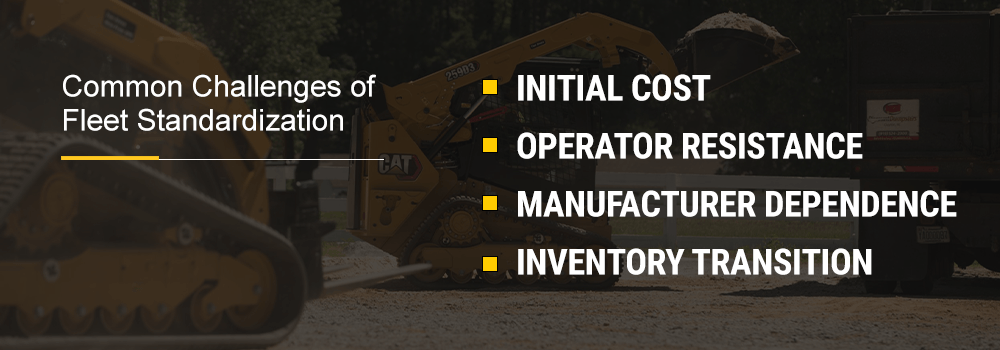
Proper planning is important to ensure you can overcome the most common challenges of fleet standardization. Some of these challenges include:
- Initial cost: Standardizing your fleet quickly often requires you to make a significant upfront investment, which can be difficult to justify to key stakeholders if your non-standard equipment still has life in it. While you can gain some money back by selling your equipment or trading it in, these processes can be costly and time-consuming.
- Operator resistance: If you switch your operators to options they’re unfamiliar with, they may be hesitant to train on and use the new standard equipment. Ensuring you have a well-developed training program to support them through the transition is essential for maximizing employee retention and productivity.
- Manufacturer dependence: Relying on a single manufacturer often makes companies feel more vulnerable to supply chain disruptions and other similar events. Choosing a supplier that operates within an extensive dealer network can help you future-proof your organization by ensuring availability through online parts ordering.
- Inventory transition: While simplified maintenance is one of the biggest benefits of fleet standardization, transitioning away from your diverse collection of parts and tools can be a complex process. Effective inventory and parts management is critical for ensuring you have components for all your equipment until your fleet is fully standardized.
Consulting with a professional to get expert advice on planning how to accomplish these tasks can be helpful.
6 Solutions for Fleet Standardization Challenges
Here are some potential solutions for the most common fleet standardization challenges:
1. Strategic Segmentation
Identify the core vehicle needs you should standardize and carefully select models that best fit those needs. Only a small portion of your fleet should include specialized models for tasks specific to your organization or industry.
When you need equipment that fulfills those purposes, you can rent it on a per-project basis from a reliable rental provider. You can also upfit standardized equipment with modular components to tailor your fleet to your typical operations.
2. Operator Buy-In
Getting your operators involved with the standardization process can help you reduce resistance. Ask them what equipment they would prefer for specific tasks to give them a sense of agency over the process.
You can get this feedback in various ways, including anonymous surveys and one-on-one meetings. The best solution for your company depends on the number of operators you have and the amount of time you can spend gathering feedback.
3. Long-Term Contracts
Negotiating long-term contracts with your equipment supplier may help you navigate potential pricing and availability challenges in the future.
This kind of agreement can help you mitigate risk by providing legal terms for you and your vendor in abnormal situations like supply chain disruptions and economic fluctuations. When you know how you and your supplier will react to these changes in advance, you can have peace of mind knowing both parties will do whatever is necessary to keep operations running.
4. Phased Implementation
Rather than purchasing all new equipment at once, taking a gradual approach to equipment replacement can help reduce costs and minimize operator resistance.
Phasing out old equipment based on its estimated life cycle will help you ensure you get the most out of your investment. That said, it’s important to keep a close eye on aging equipment as it reaches the end of its useful life — preventive maintenance is critical for avoiding unexpected breakdowns and malfunctions.
Leasing equipment is one way to gradually incorporate new equipment into your fleet without a high upfront investment. Through a capital lease, you can pay the equipment off over time and gain ownership of it at the end of the lease term.
5. Life Cycle Cost Analyses
Conducting a thorough life cycle cost analysis of your equipment can significantly increase buy-in and demonstrate the long-term savings of fleet standardization.
Here’s a quick overview of how to carry out a life cycle cost analysis:
- Determine net acquisition cost: First, total the amount you paid for the equipment. This number will include taxes and other fees included in your initial purchase.
- Establish depreciation rate: It’s important to remember that the depreciation rate of heavy equipment is different from that of road vehicles. Instead, it can help to estimate monthly depreciation by first dividing your purchase price by the number of years you plan to keep the equipment and then dividing that number by 12.
- Factor in fixed costs: Identify and include all fixed ongoing costs, such as insurance and interest.
- Calculate lifetime operating expense: Factor in all costs of ownership, including but not limited to maintenance, fuel and storage.
- Add costs together: Finally, add all the previous results together to arrive at the estimated life cycle cost of that piece of equipment.
6. Planned Replacement Cycles
Rather than waiting for equipment to unexpectedly reach the end of its life, you can maximize uptime by planning replacement intervals in advance. Then, replace the old equipment with new standard models to create a cohesive fleet.
You can calculate optimal replacement cycles by factoring in the typical lifespan for each piece of equipment in your lineup. This information may be available through your OEM or your trusted heavy equipment dealer.
How Technology Enhances Heavy Equipment Fleet Standardization
Heavy equipment technology is rapidly improving, with internet-connected systems and advanced sensors providing extensive insight into operations.
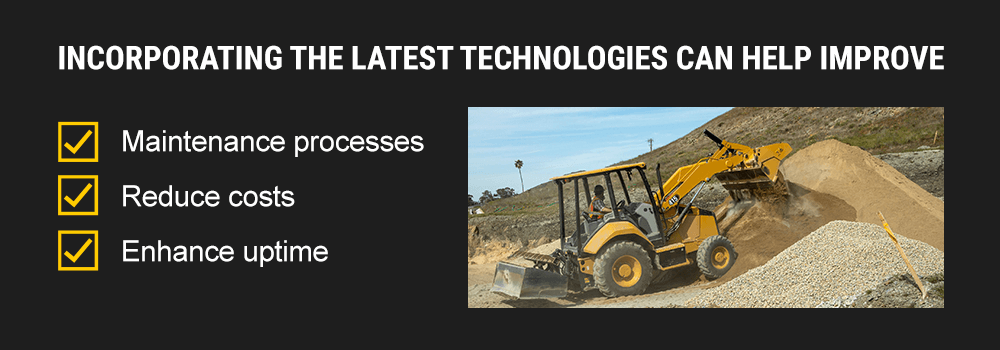
Incorporating the latest technologies into your workflows can help improve maintenance processes, reduce fleet management costs and enhance uptime.
Data-Driven Fleet Decisions
In the era of digital transformation, data-driven decision-making is more important than ever. Technologies such as the Internet of Things (IoT) and artificial intelligence (AI) enable fleet managers to rapidly collect and analyze data to generate actionable insights for improving uptime, utilization, idle time and more.
A software solution with advanced analytics capabilities can help you better understand your fleet performance and requirements by generating detailed reports on your entire fleet. Understand adherence to planned maintenance intervals, average equipment performance and utilization percentages with a centralized solution.
Modern Tools for Fleet Oversight
Taking advantage of new and emerging fleet management tools can significantly enhance your effectiveness and overall performance. Those tools and capabilities include:
- Predictive maintenance: This strategy uses advanced analytics and data collection tools to detect equipment issues in real time, enabling you to address them faster than you would with a traditional preventive maintenance schedule.
- Telematics: Implementing technologies such as Cat VisionLink can help your team maximize uptime and optimize utilization by providing visibility into your entire fleet. This all-in-one fleet management solution generates actionable insights based on data collected from your equipment so your employees can better manage your assets.
- Standardized training: Incorporating technologies like augmented reality (AR) and virtual reality (VR) into a standardized operator training program can help you ensure operators are fully trained on all required operations, including inspections and safety measures.
Standardizing Your Fleet For the Future
Companies using heavy equipment must consider how they will prepare their fleets to remain efficient and profitable in the years to come. The following are solutions for creating a forward-looking fleet.
Hybrid and Electric Equipment
As heavy equipment emissions regulations become stricter, fleet managers should consider future-proofing their fleets with standardized hybrid or electric equipment.
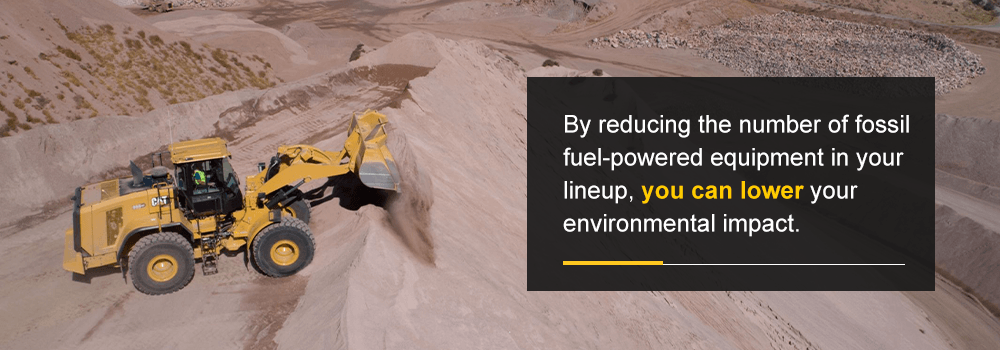
By reducing the number of fossil fuel-powered equipment in your lineup, you can lower your environmental impact and improve adherence to environmental regulations.
That said, there are some potential electrification challenges your organization should be aware of, including:
- Infrastructure availability: While experts predict charging infrastructure will become more available as electric equipment becomes more mainstream, switching to electric too quickly could make accessing the charging infrastructure your organization needs to ensure consistent operations more difficult.
- Scalability: Electric motive power often fails to scale when it comes to large equipment like excavators and wheel loaders. While research is underway to create a scalable alternative to electric, these large pieces of equipment will continue to be powered by internal combustion engines (ICE).
- Power needs: The more power a piece of equipment uses, the more time you will need to charge that equipment. This challenge can be especially frustrating for remote construction and demolition projects that lack access to charging infrastructure.
If you plan to electrify your fleet, investing in charging infrastructure before or at the same time as your new equipment is best.
Standardize Your Fleet With Premium Cat® Equipment From MacAllister
To sum it all up, building a standardized fleet can significantly enhance your business’s productivity, profitability and overall performance. If you’re looking for fleet standardization solutions, MacAllister Machinery is your ideal partner.
We are an authorized Cat dealership that provides quality equipment and maintenance, serving Indiana and Michigan’s lower peninsula. Our expert sales representatives and equipment technicians work closely with you to understand your requirements and develop tailored solutions.
Ready to start standardizing your fleet? Contact your nearest location today to set up a consultation.